Mold Testing and Inspection in Montréal
Looking for mold testing for your house, condo or plex in Montréal? I find where the moisture is coming from, test the air with samples analyzed by an independent lab, and explain the results in plain language.
A musty smell in the basement, a stain that keeps coming back on the bathroom ceiling, condensation on the windows all winter: these are the calls I get most often. I'm Pantelis Ambatzis, a Certified Master Inspector (CMI®) and an IAC2 certified mold and indoor air consultant. My job is to find the source of the moisture, see how far it has spread and, when it makes sense, measure what's in the air with samples analyzed by a lab.
When should you get a mold inspection or test?
Mold always needs moisture. If you can see it or smell it, there was water somewhere, and that water is what needs to be found first. A mold inspection makes sense when:
- you notice a musty or stale smell, especially in the basement or a closet;
- you see black, green or grey stains on a wall, ceiling, window frame or wood;
- there was a leak, a sewer backup or a flood, even if everything looks dry today;
- you're buying a property and the seller's declaration mentions past water infiltration;
- someone in the home has symptoms that get worse at home and better elsewhere (in that case, talk to your doctor too).
How the inspection works
I start by listening: what you've noticed, since when, and what has already been repaired. Then I go through the property from the outside in. Outside, I look at the grading, gutters, parging and foundation cracks, windows and roof, because that's often where the water gets in. Inside, I check walls, floors, ceilings, the basement, the attic when it's accessible, the bathroom, the kitchen and the ventilation system.
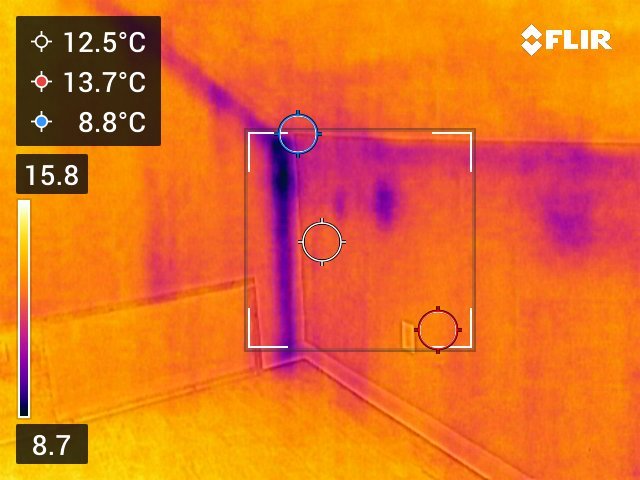
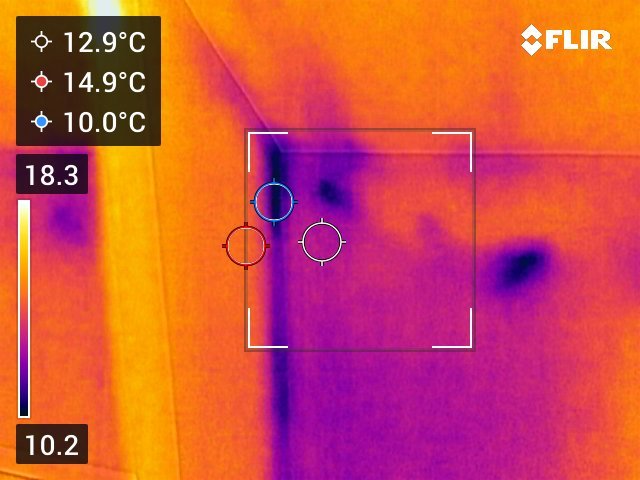
I use a moisture meter to measure moisture in materials and a thermal camera to find areas that are colder or warmer than the rest of the wall. The camera doesn't see mold or water: it sees temperature differences. It tells me where to look, and the moisture meter confirms whether there's moisture.
Air sampling and lab results
When the situation calls for it, I take air samples inside and one sample outside as a point of comparison. The samples go to an independent laboratory, which identifies and counts the mold spores. We then compare inside to outside: if the inside has a lot more spores, or types that aren't found outdoors, that's a sign of an active source in the house.
An air test doesn't replace the inspection. A normal result doesn't rule out mold hidden behind a closed wall, and a high result doesn't tell you on its own where the problem is. The inspection and the lab analysis together are what give you a useful answer.
Where mold shows up in Montréal houses
With our cold winters and damp springs, I see the same places come up again and again in Montréal:
- Finished basements, behind drywall and carpet, when the foundation lets water through or the French drain no longer does its job;
- Window frames and the corners of exterior walls, where condensation forms in winter;
- Bathrooms with no exhaust fan, or a fan that doesn't vent outside;
- Attics, when warm, humid air from the house rises and condenses under the roof;
- Older plexes, where a leak in one unit can run down into the unit below.
If the water is coming from outside, see also the page on moisture intrusion. After water damage, the flood inspection page explains how we approach it.
What you receive
I explain what I find on site, in plain language, and you receive a written report with photos, moisture readings, thermal images and, if sampling was done, the lab results. The report says where I believe the moisture is coming from, what's affected and what to do next: fix the water source, bring in a mold remediation contractor if needed, and improve ventilation. I don't do the repair work myself: my role is to give you an independent assessment.
Mold testing and hidden defects
Just bought a property and found mold behind a wall or in the basement? An independent report with photos, moisture readings, thermal images and lab results documents what is there and where the water is coming from. I have acted as an expert witness in about 16 cases before the Tribunal administratif du logement (TAL) and the civil courts, so I know what kind of evidence is useful.
Areas served
Montréal (Ahuntsic, Saint-Laurent, Rivière-des-Prairies, Montréal-Est, Anjou, Saint-Léonard, Île-des-Sœurs, Côte-des-Neiges, Westmount, Lachine, Sud-Ouest), Laval, the West Island, the South Shore (Longueuil, Brossard, Saint-Hubert) and the North Shore (Terrebonne, Lachenaie, Repentigny, L'Assomption, Lorraine, Bois-des-Filion, Sainte-Anne-des-Plaines).
Frequently asked questions
Do I need a mold test before buying a house?
Not always. During a pre-purchase inspection, I already look for visible signs of moisture and mold. If I see signs of infiltration, notice a smell or get high moisture readings, we can talk about air sampling before your inspection condition runs out.
Does a musty smell mean there's mold?
Often, yes: the smell comes from mold growing somewhere, sometimes behind a wall or under a floor. But it can also come from an old carpet or boxes stored in a damp spot. The inspection is how you tell the difference.
Can I clean the mold myself?
A small area on a washable surface, like shower grout, can be cleaned. But if the stain keeps coming back, covers a large area or is in a porous material like drywall, the moisture source has to be found and fixed first, or it will come back.
How long does it take to get results?
I explain what I find during the inspection on site. Air sampling results usually come back in about 72 hours, depending on the lab, and I go over them with you as soon as I receive them.
How much does a mold test cost?
The price depends on the size of the property and the number of air samples. Call 438-256-5323 for a same-day quote.
A smell, a stain or recent water damage? Call 438-256-5323 or reach us through the contact page.